
Connect with us

JKL

Published

on

Continue Reading

NBL

Why UCU vs Victoria University Could Be the First Round’s Best Series

Published

on

A photo montage of VU’s Mark Ngobi and UCU’s Marvin Okurut.

The 2026 National Basketball League Playoffs tip off this Friday with what could be the most intriguing first-round matchup. Fourth-seeded UCU Canons take on fifth-seeded Victoria University Crocs in a best-of-three quarterfinal series that promises intensity, contrasting basketball philosophies and no shortage of youthful ambition.

On paper, UCU enter as favourites.

The Canons finished the regular season in fourth place and completed a season sweep of Victoria University, winning 70-62 in Mukono before producing an even more convincing 82-62 victory in the return fixture at Lugogo.

Yet those two victories hardly guarantee another comfortable series.

In the first meeting, Victoria University’s Mark Ngobi erupted for 37 points in a losing effort, a reminder that one exceptional performance can completely change the complexion of a playoff game.

This rivalry stretches beyond the National Basketball League.

Last December, UCU defeated Victoria University in the University Games final, adding another chapter to what is fast becoming one of Ugandan basketball’s most exciting university rivalries. It is a matchup defined less by veteran experience and more by the confidence and energy of two young squads determined to establish themselves among the country’s elite.

Structure vs Speed

The series pits together two coaches with distinctly different offensive identities.

Under Nick Natuhereza, UCU have become one of the league’s most disciplined offensive teams. The Canons rely on structure, ball movement and balanced scoring rather than asking one player to carry the offense every night.

Jimmy Otim leads the team with 10.8 points per game, while lead guard Daniel Muganzi contributes 9.6 points per game and orchestrates the offense. Marvin Jesse Okurut provides shooting from the perimeter, Zacharia Ekirapa offers another reliable scoring threat on the wing, and the return of Blisk Ibanda after a lengthy injury gives Natuhereza another valuable rotation piece just in time for the playoffs.

Victoria University approach the game from a completely different angle.

Coach Roger Serunyigo wants his team to play fast, attack early and thrive in transition. When the Crocs are allowed to run, they become one of the league’s most entertaining offensive teams.

The Mark Ngobi factor.

The explosive shooting guard finished the regular season averaging 16.3 points per game, second only to RezLifes’ Edrine Ekau in league scoring. His ability to create offense from almost anywhere on the floor gives Victoria University a genuine game-breaker.

Alongside him, Cyrus Wobusobozi quietly enjoyed one of the league’s best playmaking seasons, averaging 4.1 assists per game, the fifth-highest mark in the NBL. Aaron Eboyu adds unpredictability in the backcourt, while Choul Deng Nyout anchors the paint with his rebounding, interior scoring and rim protection.
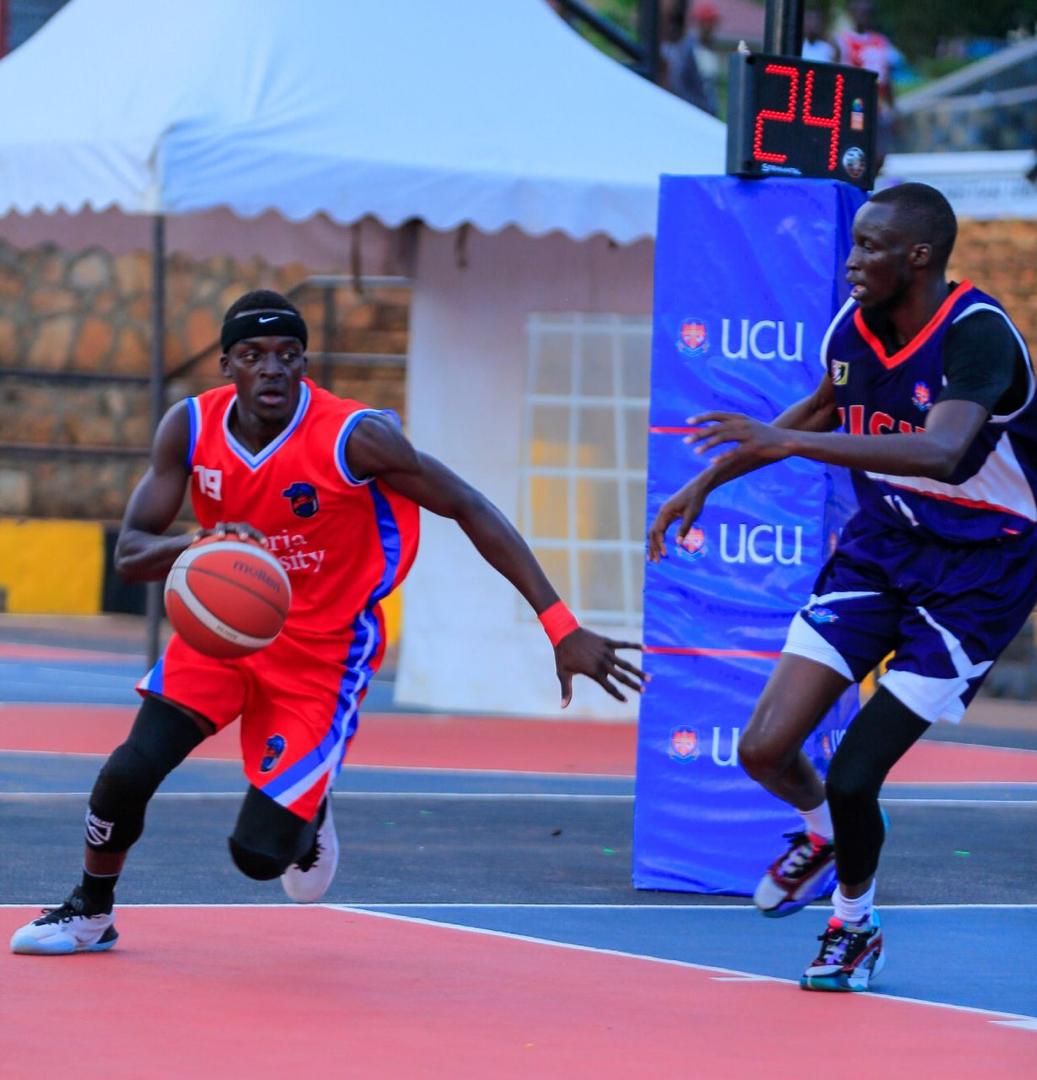
Mark Ngobi erupted for 37 points against UCU in Mukono

The Battle Inside

One area where Victoria University may hold the edge is in the frontcourt.

The Crocs have been strengthened by the return of forward Eric Komagum as well as the addition of West Wesley Serefio, giving them greater size and physicality heading into the postseason.

If Victoria University are to upset UCU, winning the paint battle could be their clearest path to victory.

UCU, meanwhile, will look to offset that advantage through movement, spacing and disciplined execution within their offensive system.

Experience Meets Momentum

Although UCU hold the higher seed, Victoria University enjoy an unusual logistical advantage.

The opening two games of the best-of-three series will both be played at YMCA Wandegeya, effectively giving the Crocs home-court familiarity despite entering as the lower seed.

It is a small detail that could become significant in such a short series.

Experience, however, remains firmly on UCU’s side.

Nick Natuhereza has guided the Canons to two National Basketball League Finals appearances and has consistently built teams that elevate their level during the postseason.

Victoria University and Roger Serunyigo are entering completely new territory.

Only a season ago, the Crocs finished ninth and missed the playoffs altogether. Their rise into the top five has been one of the league’s biggest success stories, and reaching the postseason already marks another step in the club’s rapid development.

Whether playoff experience ultimately matters remains to be seen.

The Crocs have enough talent to challenge anyone in the league, while UCU possess the structure, discipline and familiarity with playoff basketball that often separates winners from nearly-men.

If the Canons succeed in slowing the tempo and forcing Victoria University into half-court possessions, they will be confident of extending their dominance over the Crocs.

But if Ngobi catches fire, Wobusobozi controls the pace and Victoria University establish themselves in the paint, the regular season meetings may quickly become irrelevant.

With contrasting styles, rising stars, recent history and a place in the semifinals at stake, UCU Canons against Victoria University Crocs has every ingredient needed to deliver the standout series of the National Basketball League quarterfinals.

      -Basketball256 Editorial.

Continue Reading

AFRICA

Does Size Matter? The Question Uganda Basketball Can No Longer Ignore

Published

on

Egypt's giant centre Hamad Abouelrish vs Uganda. Photo by FIBA.

There is one image from Luanda circulating around Ugandan basketball circles over the last few days that may define Uganda’s FIBA World Cup Qualifying Window 3 more than any box score ever could. It shows Silverbacks and City Oilers forward Titus Lual guarding Egypt’s giant centre Hamad Abouelrish.

At 2.35 metres, Abouelrish is arguably the tallest player in international basketball today.

Outside meme-lovers caricature of it, It is an image of two athletes playing the same sport and arguably the same position—but in completely different physical realities.

Then there is Fayed Baale.

Standing at 1.73 metres (5’8″), Baale lit up Angola for 17 points and remains one of Uganda’s most electrifying guards. Remarkably, he is also among the shortest players in the current FIBA World Cup Qualifiers.

Those two images—the tallest and one of the shortest players in the competition—capture the question Uganda basketball can no longer avoid:

Does Size Matter?

The scoreboard from Luanda told one story.

The eye test told another.

Watching the Uganda Silverbacks battle Angola, Mali and Egypt during Window 3 of the FIBA Basketball World Cup African Qualifiers, one reality became increasingly difficult to ignore.

Uganda was often giving away size across multiple positions.

Not less talented.

Not less committed.

Simply… undersized.

And in basketball, that matters.

It is an uncomfortable conversation because nobody wants to reduce the game to height. Basketball has evolved beyond the era when simply having the tallest players guaranteed success. Shooting, pace, spacing, skill and decision-making now define the modern game more than ever before.

But size never disappeared.

It simply evolved.

Today’s international basketball demands players who are 6-foot-7 and can defend guards. Centres who can protect the rim and still sprint the floor. Wings with seven-foot wingspans who can switch every screen without creating mismatches.

Against Angola, Uganda spent much of the night battling Bruno Fernando around the basket.

Against Mali, the Silverbacks struggled to match the physicality of a deeper and longer rotation.

Against Egypt, Uganda competed brilliantly for forty minutes before the accumulated physical demands of the game seemed to favour the deeper, bigger team during overtime.

Three different opponents.

One recurring observation.

Uganda was often asking smaller players to perform oversized roles.

That raises a bigger question.

Is Uganda Producing Enough Size?

Uganda has wrestled with this question before.

More than a decade ago the Silverbacks attempted to add size through players like Sam Gombya and Marial Dhal. The experiment never fully matured, while Stanley Ocitti later became arguably Uganda’s most impactful modern power forward, playing a pivotal role in the team’s historic qualification for AfroBasket 2017.

Since then, however, Uganda has largely returned to building around guards.

Perhaps the issue isn’t that Uganda lacks tall people.

Perhaps the issue is that Ugandan basketball isn’t finding them early enough.

How many players taller than 6-foot-7 are currently in structured basketball programs?

How many secondary schools actively recruit exceptionally tall students into basketball rather than letting them drift into other sports—or no organized sport at all?

How many strength and conditioning programs are designed specifically around developing young post players instead of simply producing guards?

These questions matter because international basketball increasingly rewards countries that identify physical tools early and develop skills around them.

Can Uganda Manufacture Size?

No.

Height cannot be coached.

But length can be identified.

Strength can be developed.

Mobility can be trained.

Timing can be taught.

Skill can absolutely be built.

Countries with limited basketball traditions have dramatically improved by creating deliberate pathways for taller athletes. Uganda can do the same if the federation, schools, academies and clubs align behind a long-term vision.

That vision begins with recognizing that frontcourt players require different development. A 6-foot-9 teenager should not necessarily be trained exactly like a 6-foot point guard.

The Future Is Bigger—But Also Smarter

This should not become a search for height alone.

Uganda has always produced skilled guards. Over the decades, I can name but a few, Jimmy Enabu, Tony Drileba, Mark Okidi, Cyrus Kiviiri, Josh Johnson, Kassim Namgwere, to the current crop of guards. That identity should remain.

The next step is balance.

Imagine Uganda’s talented backcourt complemented by two or three homegrown forwards standing 6-foot-8 or taller, comfortable defending, rebounding and finishing above the rim.

That changes everything.

It changes defensive schemes.

It changes rebounding battles.

It changes transition opportunities.

Most importantly, it changes expectations.

My Conclusion

Window 3 exposed many things about the Silverbacks.

Execution can improve.

Turnovers must decrease.

Closing games remains a work in progress.

But perhaps the biggest lesson wasn’t tactical at all.

Window 3 suggested that Uganda’s greatest long-term challenge may not simply be Angola, Egypt or Mali. It may be matching their physical profile.

If Uganda wants to become a consistent contender in African basketball over the next decade, developing bigger, longer and more versatile frontcourt players cannot remain an afterthought.

The conversation shouldn’t be about whether size matters.

At this level, it clearly does.

The conversation should be about what Uganda is prepared to do about it.

By Cucu Brian.

The views expressed herein are only the views of the author. Brian is an ardent Ugandan basketball follower, a basketball junkie and the founder of Basketball256 LLC.

Continue Reading

AFRICA

Six Lessons the Silverbacks Must Take from a Difficult Window 3 Campaign

Published

on

Results rarely tell the whole story.

On paper, Uganda leaves Luanda with three defeats from three games after losses to Angola (95-62), Mali (82-59) and Egypt (77-70 in overtime).

But beneath those results lies a qualifying window full of valuable lessons—some encouraging, others brutally honest.

For a Silverbacks program still striving to establish itself among Africa’s basketball elite, Window 3 exposed both the progress Uganda has made and the distance still left to travel.

1. Forty Minutes Is No Longer Enough

If there is one lesson that defined Uganda’s campaign, it is this: international basketball punishes every lapse.

Against Angola, the Silverbacks were within seven points at halftime before a devastating 20-0 run ended the contest.

Against Egypt, Uganda led for more than 24 minutes and held a two-point advantage with less than a minute remaining, only to lose in overtime.

The Silverbacks proved they can compete.

Now they must prove they can finish.

Elite African teams don’t necessarily play better basketball for forty minutes—they simply execute better during the five or six possessions that matter most.

2. Uganda Has Reliable Scorers

One of the biggest positives from Luanda was the emergence of multiple offensive contributors.

Fayed Baale announced himself against Angola with 17 points while shooting five three-pointers.

Leonard Musiime matched that scoring output against the Palancas Negras.

Deng Geu led Uganda against Mali with 13 points.

Nike Sibande was consistently excellent throughout the window, culminating in a superb all-around performance against Egypt with 19 points, six assists and three steals.

For years, Uganda has searched for dependable offensive options.

Window 3 suggested the Silverbacks are beginning to build that depth.

3. Turnovers Continue to Be the Biggest Enemy

The numbers repeatedly pointed to one issue.

Against Angola, turnovers fuelled the decisive 20-0 run.

Against Egypt, Uganda struggled to execute late possessions in regulation and overtime.

At this level, every turnover becomes a transition opportunity for opponents who rarely waste them.

Protecting the basketball is no longer just a statistical category—it is the difference between winning and losing.

4. Experience Still Separates Uganda from Africa’s Elite

Angola never panicked after falling behind.

Mali controlled the game without needing spectacular scoring runs.

Egypt erased a 12-point first-quarter deficit before calmly executing in overtime.

The common thread was experience.

These are programs accustomed to winning pressure games.

Uganda’s young core is still learning those lessons in real time.

The encouraging part is that such experience cannot be taught in practice—it can only be earned through games like these.

5. The Future Remains Bright

Three defeats should not overshadow the bigger picture.

Uganda competed with Egypt until overtime. The Silverbacks challenged Angola for an entire half. Young players continued to grow in confidence while established leaders embraced larger responsibilities.

There were frustrations, certainly.

But there were also signs that Uganda’s basketball program continues to mature.

The gap between the Silverbacks and Africa’s traditional powers is no longer about talent alone.

It is about consistency, execution and experience. Those qualities are developed over years, not weeks.

6. Size Still Matters—Perhaps More Than We Want to Admit

This may be the most uncomfortable lesson from Luanda.

Uganda looked smaller.

Against Angola’s Bruno Fernando and a physically imposing frontcourt, against Mali’s length across multiple positions, and against Egypt’s interior presence led by Assem Marei, the Silverbacks often found themselves giving away inches, wingspan and physicality before the opening tip.

International basketball has evolved dramatically over the last decade. The game is faster, more perimeter-oriented and increasingly positionless. But one truth has remained remarkably consistent:

Size still wins possessions. Size secures rebounds. Size alters shots. Size changes passing angles. Size allows defenses to switch without constantly needing help.

Throughout Window 3, Uganda’s margin for error was noticeably smaller because its margin in size was equally small.

That is not a criticism of the players who wore the Silverbacks jersey. They competed relentlessly against bigger opponents. Rather, it is a challenge to Ugandan basketball as a whole.

Where are the next generation of 6-foot-7 forwards? Where are the mobile seven-foot centers? How many players above 6-foot-6 are currently being developed through Uganda’s schools, academies and clubs?

These questions should now become part of the national basketball conversation.

Because while skill can neutralize size for stretches, over the course of forty minutes against elite African opposition, size remains one of basketball’s greatest competitive advantages.

The Silverbacks don’t necessarily need to become the tallest team in Africa.

But they do need to become bigger.

Hamad Abouelrish of Egypt vs Uganda in Window 3, Luanda. Hamad was a tower the Silverbacks had to tussle with.

The Basketball256 Verdict

Window 3 was not the campaign Uganda hoped for. Neither was Window 2 in Alexandria.

It was, however, a reminder that international basketball is often decided by details rather than talent. The Silverbacks leave Luanda without a victory but with something equally valuable: clarity.

They now know they can compete with Africa’s best. The next step is learning how to beat them. That journey will not be defined by this FIBA World Cup 2027  qualifying campaign.

It will be defined by how Uganda responds to the lessons learned in Alexandria last February and in Luanda this July.

Continue Reading

AFRICA

Silverbacks Let Victory Slip Away as Egypt Complete Overtime Comeback in Luanda

Published

on

The Uganda Silverbacks came within seconds of ending their FIBA Basketball World Cup 2027 African Qualifiers Window 3 campaign on a high before Egypt staged a dramatic late comeback to claim a 77-70 overtime victory on Sunday at the Pavilhão Multiusos de Luanda.

For more than three quarters, Uganda looked the better side. The Silverbacks played with energy, defended aggressively and executed well enough to lead for over 24 minutes of game time. But as has often been the case against Africa’s established basketball powers, the closing moments proved decisive.

Egypt outscored Uganda 21-11 during the final nine minutes—including overtime—to snatch a victory that had appeared to be slipping away.

Turning Point: Abdelhalim Sends the Game to Overtime

Uganda entered the final minute clinging to a 67-65 advantage and appeared poised to secure its first win of the qualifying window.

Then Amr Abdelhalim delivered the defining moment of the contest.

With just 39 seconds remaining, the Egyptian guard floated home the tying basket to level the score at 67-67, silencing Uganda’s momentum and forcing an extra five minutes.

That shot completely shifted the complexion of the game.

From the closing seconds of regulation through the opening minute of overtime, Egypt outscored Uganda 6-3 while converting three of its four field-goal attempts. Uganda managed only one basket and a free throw during the same stretch, allowing the North Africans to seize control for the first time when it mattered most.

By the time the Silverbacks found another rhythm offensively, Egypt had already built a four-point cushion that proved insurmountable.

Uganda’s Dream Start

Ironically, Uganda had produced perhaps its best basketball of the entire Luanda window during the opening quarter.

The Silverbacks raced into a stunning 17-5 lead with 5:45 remaining in the first period, stunning the Egyptians with relentless defensive pressure and composed offensive execution.

At one stage, Uganda led by 12 points—the biggest advantage enjoyed by either team all afternoon.

Egypt, however, never panicked.

Gradually, the Pharaohs chipped away at the deficit before eventually drawing level at 23-23 midway through the second quarter. From there, the contest evolved into a back-and-forth battle featuring eight lead changes before overtime finally separated the two sides.

Sibande Does Everything but Finish the Job

If one player embodied Uganda’s effort, it was Nike Sibande.

The American-born guard delivered his most complete performance of the qualifying window, finishing with 19 points, four rebounds, six assists and three steals while playing all 45 minutes.

He converted 10 of his 15 free-throw attempts and repeatedly attacked the basket when Uganda needed offense, scoring six points during crunch time.

Yet even Sibande’s all-round brilliance could not prevent Egypt’s late surge.

SIlverbacks Nike Sibande vs Egypt

Abdelhalim Leads Egypt’s Charge

Egypt found its hero in Amr Abdelhalim.

The guard finished with a game-high 20 points while shooting 8-of-14 from the field and knocking down two three-pointers. More importantly, he delivered when the pressure peaked.

His game-tying basket forced overtime before Egypt’s experienced core took control during the extra session.

Assem Marei then dominated crunch time with four points, five rebounds and two assists, helping Egypt own the paint when the game hung in the balance.

The Difference Was Execution

Statistics rarely lie.

Uganda led for 24 minutes and 35 seconds compared to Egypt’s 17:23.

The Silverbacks built the game’s largest lead.

They answered Egypt’s runs with an 8-0 burst early in the fourth quarter that turned a four-point deficit into a four-point lead.

But basketball games are decided in moments, not minutes.

When execution mattered most, Egypt produced cleaner possessions, controlled the rebounds and converted high-percentage shots inside the paint. Uganda, meanwhile, struggled to manufacture quality looks in overtime and increasingly relied on trips to the free-throw line.

That contrast ultimately decided the contest.

A Painful But Encouraging Defeat

The final score will record another loss for the Silverbacks.

Yet unlike the defeats to Angola and Mali, this one offered genuine evidence that Uganda can compete with Africa’s elite.

The challenge now is learning how to close games.

Against experienced international teams, a forty-minute performance is rarely enough. Sometimes, as Uganda discovered in Luanda, it requires forty-five.

Continue Reading
Advertisement
Advertisement

FEATURED STORIES