

In a bid to play for Nigeria’s female national basketball team, D’tigress at the ongoing 2021 Olympics in Tokyo, Japan, three Women National Basketball Association (WNBA) stars; Nneka Ogwumike, Chiney Ogwumike, and Elizabeth Williams declared their interest to represent Nigeria. The three all have dual citizenship in the United States and Nigeria. Indeed, when the Nigeria Basketball Federation (NBBF) revealed its provisional D’Tigress, the three WNBA stars were included in the team. All the three have dual citizenship in the United States and Nigeria
Nneka Ogwumike, a former WNBA Most Valuable Player (MVP), and Elizabeth Williams have previously been involved with the U.S National Women’s basketball team with the former playing in two FIBA world cups while Chiney Ogwumike had not yet played for the U.S in any FIBA tournament. The two Ogwumike sisters had intended to join their young sister, Erica who had already been included on the Nigerian roster.
The Federation of International Basketball Association (FIBA) bars players above 17 years of age from switching nationality after playing in a FIBA tournament for a country. However, there is an exception where FIBA may allow a player to play for the national team of his or her country of origin if this is in the interest of the growth of basketball in that country.
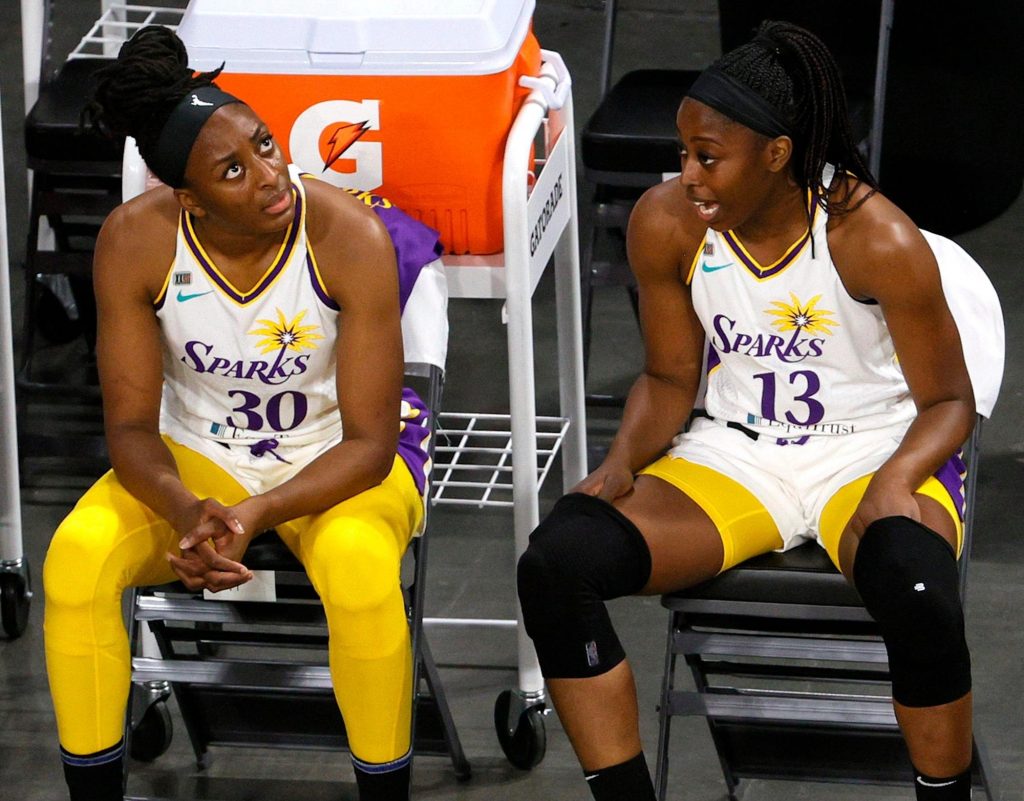
FIBA denied Nneka Ogwumike and Elizabeth Williams the opportunity to play for the D’Tigress arguing that the two had been substantially involved with the U.S national women’s basketball team for them to fall within the exception. Chiney Ogwumike was authorized to play as a naturalized Nigerian, something she contested because Erica Ogwumike, her sister has similar status and has never competed for the U.S at any level had been cleared to play as a normal Nigerian citizen. The trio appealed to the Court of Arbitration for Sport (CAS) asking the Court to allow them to compete for the D’Tigress on a provisional basis until after the games when CAS would be able to conduct a full hearing and determine the matter on its merits.
CAS upheld FIBA’s decision provisionally pending a full hearing.
Basketball nationality
CAS has overtime emphasized the view that sporting bodies have the authority to regulate sporting nationality[i]. The CAS has further advised that:
“A person may have two or more nationalities, but every athlete can only have one sporting nationality…when the athlete has made his choice as to his sporting nationality, the possible benefits of dual nationality will disappear…”[ii]
The CAS is not bound by the ‘doctrine of precedent’ or ‘Stare Decisis’, however, CAS awards (decisions) are of persuasive value in the wider Lex Sportiva-distinct universal principles of sports law developed especially by CAS and international sports federations. This topic divides opinion among many sport law scholars.
Be that as it may, there are two CAS awards that could particularly come in handy here:
Belize Basketball Federation V FIBA[iii]
In 2009, the Belize Basketball Federation (BBF) submitted a list of players that it intended to represent it in a basketball tournament. BBF, went ahead in pursuit of confirming the eligibility of the players to submit the official birth certificates of the players’ parents, copies of their passports, and certificates of affirmation of Belizean nationality.
True to form, FIBA questioned the nationality status of these players. FIBA argued that contrary to its Internal Regulations. Except for two players, FIBA established that the players had acquired their Belizean nationality after having attained the age of sixteen-they were in fact all above twenty years. The particular provision, ‘Article H.2.3.3’ of the FIBA Internal Regulations then which is pari materia with FIBA’s current ‘FIBA Eligibility and National Status of Players’ status Regulations was couched as follows:
“A National team participating in an international competition of FIBA may have only one player on its team who has acquired the legal nationality of that country by naturalization or by any other means after having reached the age of 16.”
Despite a spirited fight from the BFF where they enlisted the support from the Belizean Director of Immigration and the equivalent of the country’s top legal advisor who wrote letters to FIBA guiding on Belizean nationality. In essence, what the Belizean government officials advised was that one can acquire Belizean nationality is by descent if, at the time of their birth, one or both of their parents is a citizen of Belize. They also stated that the Certificate of Affirmation of citizenship which FIBA based on as proof that the players had not claimed their Belizean nationality by the age of sixteen was merely declaratory and not constitutive as far as Belizean nationality is concerned. BFF appealed to CAS.
The question before CAS for determination was whether the impugned Article H.2.3.3 of the FIBA Internal Regulations was applicable to the dispute.
The CAS reversed FIBA’s decision. It agreed with BFF’s argument that the Certificate of Affirmation of Belizean nationality was of a declaratory, not constitutive nature for purposes of Belizean nationality-that it was simply ‘procedural, administrative and not substantive’.
CAS held that the players had acquired the nationality of Belize by descent at birth and were all therefore of Belizean nationality and had attained that nationality before their sixteenth birthday. In holding that, Court held that the impugned Article H.2.3.3 did not apply to this case.
CAS further criticized FIBA for relying on Article H.2.3.3 and focusing exclusively on nationality criteria as opposed to for example the period of time played in national competitions. It suggested that if FIBA indeed wanted to keep out players with no previous track record in national competitions of a particular country from representing the same country’s national team, other than relying on the impugned rule as it was then, it had to formulate other rules.
The Court did take note of FIBA’s submission to the effect that it was concerned with the prevention of nationality laws as states sought to nationalize foreign players in the pursuit of sporting success. FIBA stated that it had a duty to preserve a level playing field in national team competitions and that Article H.2.3.3 was important to achieve that goal.
“…absent this provision, the undesirable phenomenon of professional players acquiring the nationality of another country merely to facilitate their participation in the national team of that country (and thus to increase their market value) would inevitably increase. As a result, national teams would increasingly be composed of players who had never participated in their national championships and there would be, not infrequently, a substantial discrepancy between the sporting quality of the national team and that of national competitions.”
In obiter dictum remark, the panel acknowledged the aforementioned view and added that there was indeed a need to preserve a link between national team competitions and national teams and that it was important to avoid a ‘situation in which national teams are substantially or wholly composed of sporting mercenaries acquiring belatedly nationalities of convenience’
Spanish Basketball Federation V FIBA[iv]
The Spain Basketball Federation contested FIBA’s decision that had allowed the legendary female basketballer, Natalia Zassoulskaia’s to play for Russia at the FIBA World Championships in 1998. Spain had argued that Natalia Zassoulskaia was already a citizen of Spain and had gone ahead to obtain the basketball nationality of Russia illegally.
The Spanish Basketball Federation lost because it was discovered that Natalia Zassoulskaia had held USSR/Russian nationality before she obtained Spanish nationality which she had not renounced and had competed for USSR/Russia in a FIBA tournament previously.
CAS further held that neither FIBA Eligibility department nor the Central Board are Courts of Law. These bodies are empowered to deal with certain matters arising during the course of the administration of sport. Any judicial body subsequently examining such matters should be reluctant to impose on the sports body a materially different standard of proof or evidence than that which the parties accepted through their membership of the sports body.
These cases, BFF V FIBA (supra) and the Spanish Basketball Federation V FIBA (supra) show that it is possible for a party to triumph over a sports body in conflict of laws dispute between domestic nationality and sporting/basketball nationality.
The Lex Sportiva has its claims to being an autonomous legal order by and large created by private global institutions that govern international sport and CAS. It is not governed by national legal systems. It is a ‘Sui generis’ set of legal norms not found elsewhere. Characteristically, there will be a contractual arrangement between domestic sports bodies and international sporting federations making the domestic sports `federations/ bodies submit to the authority of the international sporting federations. With this comes self-regulation by international sporting institutions or accepted external ones. Sports law in essence attempt to take away the power of states to regulate it.
Therefore national laws will often find themselves in conflict with sports law, it is not surprising that these duels between nationality/citizenship as defined by the laws of a particular State versus basketball/sports nationality set out by FIBA are commonplace in the basketball world.
This eligibility rule continues to deal its fair share of controversy which has not just started with the Ogwumike sisters-why was Chiney Ogwumike who had never played for the U.S before declared a naturalized citizen and yet her sister, Erica Ogwumike was given normal Nigerian status? As a Ugandan, I remember being blown away by John Baliwigaire, a Ugandan-American who had helped steer Uganda to its first Afro-basket competition in 2015 in Tunisia and along the way had put up some spell-binding performances notably his clutch shots against the Egyptians. He was unfortunately declared ineligible to play in that tournament and indeed the Ugandan Silverbacks missed him as they went ahead to finish 15th in that tournament. It is the same rule that has stood in the way of Jordan Clarkson of the Utah Jazz and current NBA sixth man of the year playing for the Philippines basketball team.
FIBA perhaps has legitimate concerns in preventing ‘the undesirable phenomenon of professional players acquiring the nationality of another country’ to up their value in the market, something which is indeed currently happening. It is also true that increasingly, there is a huge gulf in class in many African national teams and their domestic leagues.
However, this is not unique to basketball, the same is true for other sports especially football-a typical national team of an African country will comprise majorly professionals plying their trade in more lucrative leagues in Europe or elsewhere. Speaking of football, FIBA might have a lot to learn from the Federation of International Football Associations (FIFA)’s eligibility rules which are way more flexible.
In my opinion, undoubtedly, there is a need for reform of the FIBA eligibility rules and perhaps this Ogwumike sisters-Elizabeth Williams dispute with FIBA is a blessing in disguise and could go a long way in leading the way as far as reforming the said eligibility criteria. The odds seem stuck against two of them though; Nneka Ogwumike and Elizabeth Williams look like disgruntled ‘mercenaries’ who only remembered their Nigerian nationality belatedly after being dropped by the U.S female basketball team with which they had been involved for a while, and CAS’ characteristic deference to international sports bodies and its not being bound by the doctrine of precedent. Chiney Ogwumike should be able to be declared a Nigerian citizen and not naturalized for basketball purposes unless otherwise.
I await with bated breath for the full hearing of this matter and the subsequent decision and so should all African basketball federations.
Authored by Ivan A. Ojakol
[i] TAS 92/80 B. V Federation Internationale de Basketball (FIBA)
[ii] CAS 98/2 15 International Baseball Association
[iii] Arbitration CAS 2009/A/1988 Belize Basketball Federation v. Fédération Internationale de Basketball (FIBA), award of 20 April 2010
[iv] Arbitration CAS 98/209 Spanish Basketball Federation / FIBA, award of 6 January 1999


Must See


